What FEOC Rules Mean for the Solar Industry in 2026

 2026-06-17
What FEOC Rules Mean for the Solar Industry in 2026
For years, the solar industry has largely focused on three things: lowering costs, speeding up installations, and maximizing tax incentives. Now, there’s a fourth factor that’s becoming impossible to ignore: supply chain compliance.
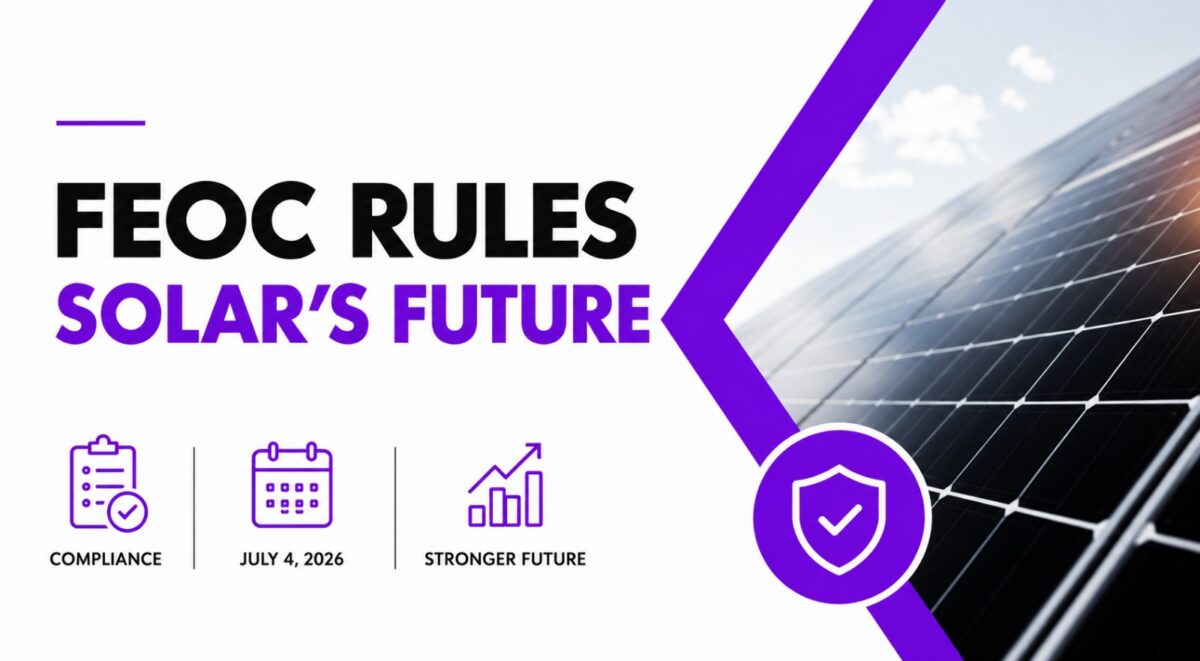
Beginning July 4, 2026, new FEOC (Foreign Entity of Concern) stipulations tied to federal clean energy tax credits will begin to reshape how solar projects are designed, sourced, financed, and approved. For developers, EPCs, manufacturers, and even commercial property owners, these changes represent one of the biggest structural shifts the industry has seen since the Inflation Reduction Act.
And while the language around FEOCs can feel highly technical, what it means in plain speak is actually quite simple: where your solar equipment comes from is about to matter far more than it used to.
At IE Construction, we’re already helping clients prepare for these changes before deadlines start to create major bottlenecks across the industry.
What Are Foreign Entities of Concern?
A Foreign Entity of Concern is a term that refers to certain companies, organizations, or entities connected to countries the U.S. government considers strategic risks to national security. Under current Department of Energy guidance, those nations include the People’s Republic of China, Russia, Iran, and North Korea.
The FEOC guidance was initially developed around battery manufacturing and critical mineral supply chains, but its influence now extends directly into renewable energy development and solar tax credit eligibility.
Under the newer federal energy legislation, projects with significant ties to FEOCs may become ineligible for valuable clean energy tax credits, including Section 48E credits widely used in commercial solar development.
If your project relies on prohibited foreign sourcing, ownership structures, or manufacturing relationships, your project could lose access to federal incentives.
The FEOC Compliance Deadline
July 4, 2026 is one of the key compliance deadlines established under the updated clean energy framework. Projects looking to qualify for full 48E tax credit treatment must commence construction before this date or meet aggressive placed-in-service deadlines afterward.
At the same time, FEOC sourcing restrictions will start to tighten considerably. Developers will no longer be able to treat procurement as a late-stage decision. Supply chain verification now has to happen early, often before financing is finalized.
This can pose a challenge, and a major operational shift, for many in the industry. Historically, solar procurement has been cost-driven, with developers sourcing modules, inverters, batteries, and other components from the most competitive global suppliers available. In many cases, that meant relying heavily on Chinese manufacturing because of pricing and scale advantages, but now, compliance itself has become an even more important part of project viability.
What This Means for Commercial Solar Customers
If you’re a commercial property owner considering solar, you might not be dealing directly with FEOC compliance paperwork, but you’ll almost certainly feel the effects indirectly.
First, equipment sourcing will become more important, with conversations around domestic manufacturing, approved vendor lists, supply chain tracing, U.S.-assembled components, and compliance certifications rising to the forefront. Where once these may have just been marketing speak, they’re now financial necessities for projects that are trying to preserve any tax credit eligibility.
Some projects may become more expensive as a result, since stricter sourcing requirements organically increase costs. For years, global manufacturing efficiencies have helped to drive solar prices downward. But restricting portions of the supply chain may temporarily increase equipment pricing, particularly for high-demand compliant components.
That said, many commercial solar customers may still come out ahead financially if projects remain eligible for major federal incentives. For commercial projects, losing eligibility for Section 48E tax credits can significantly alter project economics, investor returns, financing structures, and overall payback periods. In many cases, maintaining compliance will outweigh the additional procurement costs associated with approved equipment sources.
Either way, as deadlines approach, expect:
- Longer lead times
- Increased permitting backlogs
- Equipment shortages
- Higher demand for compliant products
- More competition for qualified installers
We’re already seeing developers move projects forward to avoid getting caught in future supply chain constraints.
What This Means for Developers, EPCs, and Procurement Teams
This is where FEOC rules become more operationally complex:
Procurement Carries Compliance Risk
For years, most solar procurement decisions came down to a relatively straightforward equation: performance, availability, and price.
But under the new FEOC framework, developers and solar sellers now have to think much more carefully about where equipment comes from and who’s connected to it behind the scenes.
This requires more than just evaluating equipment specifications and pricing: companies may now need to examine manufacturer ownership structures, supplier relationships, manufacturing locations, licensing agreements, and even the percentage of materials sourced from potentially restricted entities.
Under current DOE guidance, even indirect ownership or certain contractual relationships can create FEOC concerns. As a result, due diligence is becoming a much larger part of the development process than it was just a few years ago.
Supply Chain Documentation is Paramount
Supply chain documentation is also becoming increasingly important. Moving forward, developers will likely need much greater transparency throughout the procurement process, including traceable sourcing records, manufacturing certifications, and detailed documentation showing where components originated and how they were produced.
In some cases, that information may need to be verified before financing can close or tax credit eligibility can be confirmed.
The broader shift will likely be harder to ignore. Compliance is no longer just an issue for your legal or accounting teams to solve, but is now part of project development itself.
The Role of Domestic Partnerships
Domestic partnerships are becoming significantly more valuable. As the federal government pushes to reduce reliance on foreign-controlled supply chains, solar companies are placing greater emphasis on working with compliant manufacturers, U.S.-based suppliers, and experienced construction partners who already understand these evolving regulations.
For developers who prepare early, that shift may ultimately become a competitive advantage rather than just another layer of paperwork.
Implications Beyond Compliance
While FEOC regulations may initially seem focused on tax credit compliance, their impact extends far beyond tax credits. They are part of a broader effort to reshape the entire American energy supply chain.
The solar industry grew incredibly fast over the last decade, but much of that growth relied heavily on overseas manufacturing capacity. Policymakers now view that dependence as both an economic and national security vulnerability.
Whether you agree with the policy direction or not, the practical reality is clear: the industry is entering a new phase where sourcing strategy matters almost as much as engineering strategy.
How to Prepare for FEOC Regulations Now
While FEOC regulations are still evolving and won’t go into effect until the summer of 2026, there are a few steps you should take to reduce your risk and avoid future project delays:
- Audit Your Supply Chain Early: Don’t wait until procurement is finalized to understand where components are being manufactured or how suppliers are structured. The earlier potential compliance issues are identified, the easier they are to address.
- Vet Vendors Carefully: Price and availability still matter, but developers should also be evaluating ownership structures, sourcing transparency, manufacturing locations, and supplier documentation processes before committing to long-term partnerships.
- Be Prepared to Shift Project Timelines: Because FEOC verification and sourcing reviews can add additional layers to procurement, many developers are beginning projects earlier to avoid getting caught in permitting, supply chain, or equipment bottlenecks later.
- Build In Compliance Checks: Rather than treating FEOC review as a separate legal step at the end of the process, many companies are integrating compliance review into vendor selection, purchasing, and project planning from day one.
- Avoid Last-Minute Sourcing Decisions: As deadlines approach and demand for compliant equipment increases, availability could tighten quickly. Waiting too long to secure approved components may limit options, increase costs, or create unnecessary project delays.
Get Ready for the Next Phase of Solar with IE Construction
The reality is that FEOC rules are changing how solar projects get built. Companies that adapt early will likely have far more flexibility than those scrambling to react later.
At IE Construction, we’re helping developers, commercial property owners, and energy stakeholders navigate evolving FEOC requirements while building projects designed for long-term compliance, financing eligibility, and operational stability.
The biggest mistake is assuming these rules only affect utility-scale developers. In reality, FEOC stipulations are influencing every level of commercial solar development, from corporate procurement decisions and distributed generation projects to large-scale energy infrastructure investments.
The earlier you prepare, the more options you’ll have. Get in touch with IE Construction today to stay one step ahead of the regulations.